
Representing a client before the Immigration and Refugee Board (IRB) is a different discipline from preparing an application. You are dealing with hearings, evidence, credibility and written argument. For licensed consultants who want to add that work to their practice, the RCIC-IRB Specialization exam is the next step, and preparing for it deserves its own plan.
Why the IRB is a different kind of practice
An application is mostly about documents and eligibility. An IRB matter is about a decision-maker, a record and a process. You have to understand how each division works, what standard it applies, which rules govern evidence and time limits and how to present a client's case in writing and at a hearing.
That is why this exam is positioned for licensed consultants rather than newcomers. Always check the College of Immigration and Citizenship Consultants (CICC) for the current requirements, eligibility and exam details.
The four divisions you need to know
- The Immigration Division deals with admissibility hearings and detention reviews.
- The Immigration Appeal Division (IAD) hears appeals, including humanitarian and compassionate jurisdiction.
- The Refugee Protection Division (RPD) decides refugee claims, including questions of exclusion, credibility, state protection and internal flight alternatives.
- The Refugee Appeal Division (RAD) hears appeals from RPD decisions, with its own time limits, record and rules on new evidence.
Each division has its own procedure, so a good study plan treats them separately and then ties them together with the cross-cutting skills: administrative law, standards of review, research, argument and advocacy.
What the course covers
The course is organised into six modules, from IRB foundations and professional duties through each division to evidence, research, advocacy and critical thinking.
What the course covers
- IRB Foundations, Administrative Law and Professional Duties (5 lessons)
- Overview of the IRB and Its Divisions
- Principles of Procedural Fairness and Natural Justice
- Standards of Review in IRB Decisions
- Professional Duties Under the CICC Code of Conduct
- Scope and Limits of the RCIC-IRB Licence
- Immigration Division (5 lessons)
- Admissibility Hearings: Process and Criteria
- Detention Reviews: Procedures and Criteria
- Preparing Applications and Submissions
- Decision-Making in the Immigration Division
- Remedies After a Negative Decision
- Immigration Appeal Division (4 lessons)
- Jurisdiction and Appeal Routes of the IAD
- Humanitarian and Compassionate Jurisdiction
- Preparing Evidence and Witnesses for IAD Hearings
- Legal Issues on Appeal and Preparing for Stays
- Refugee Protection Division (5 lessons)
- Claiming Refugee Protection: Eligibility and Process
- Exclusion and Credibility in Refugee Claims
- State Protection and Internal Flight Alternative
- Preparing the Basis of Claim and Evidence
- Hearing Preparation and Decision Analysis
- Refugee Appeal Division (4 lessons)
- Who Can Appeal and Time Limits
- Preparing the Appellant's Record and Memorandum
- Rules on New Evidence in RAD Appeals
- Analyzing RAD Decisions and Next Steps
- Evidence, Research, Advocacy and Critical Thinking (5 lessons)
- Conducting Legal Research for IRB Cases
- Developing Case Strategies and Legal Arguments
- Enhancing Written and Oral Advocacy Skills
- Improving Client and Witness Communication
- Evaluating Options and Problems in IRB Cases
A study approach for experienced consultants
- Start with the foundations. Procedural fairness, natural justice and standards of review underpin every division.
- Take one division at a time. Finish its module before moving on, and write a one-page summary of how a file moves through it.
- Practise the written side. Draft a short submission or memorandum from a hypothetical fact pattern.
- Finish with evidence and advocacy. These skills show up in every division.
At roughly 120 hours of material, plan on two to three hours a day, or a lighter pace spread across the 3-month access period.
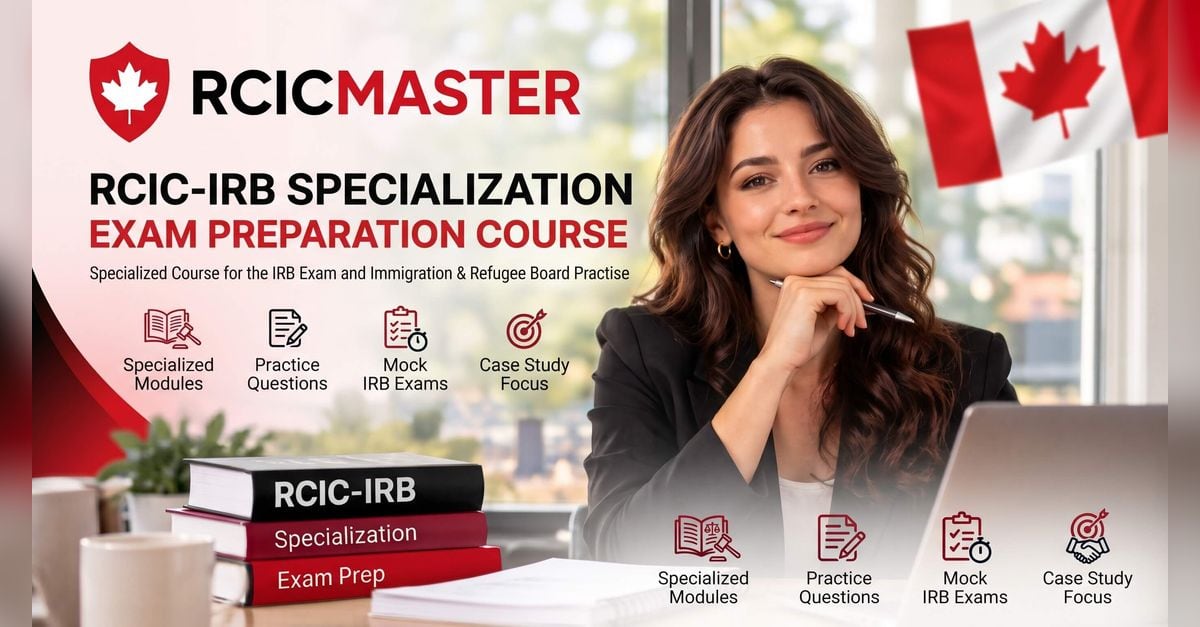
See the full syllabus and enroll
RCIC-IRB Specialization Exam Preparation Course · CAD $149 one-time payment · 3 months
Read every module and lesson before you buy. One payment, no subscription.
View the courseThis is practice preparation and is not endorsed by the regulator.
FAQ
Who is this course for?
It is designed for licensed consultants who want to prepare for the RCIC-IRB Specialization exam and to represent clients effectively before the IRB.
How much does it cost?
CAD $149, one-time payment, with 3 months of access.
Is it endorsed by the regulator?
No. It is practice preparation and is not endorsed by the College.
Can I read the syllabus first?
Yes. Every module and lesson is listed above and on the course page, so you can judge whether it matches what you need.