
Study permit and PGWP files look simple from the outside: a student, a school, a program. In practice they are full of small decisions, and a small mistake can end a client's plan. This guide explains where those decisions are, and how focused study helps both exam candidates and working consultants.
Checkpoints on a study permit file
Policies in this area change often, so treat the following as a checklist of questions, not as current rules. Always confirm current requirements with IRCC.
- Is the school a designated learning institution (DLI)? The client's school and program have to qualify.
- Can the client show proof of funds? Financial evidence is often the weakest part of the file.
- Is the program of study consistent with the client's history and plan? Officers look at whether the application makes sense as a whole.
- Are the documents complete, consistent and truthful? This leads directly into misrepresentation, which has serious consequences.
Checkpoints for the PGWP
- Does the client's program and institution qualify for a PGWP?
- Is the client still in status, and is the application within the allowed time frame?
- Is there a language or field-of-study requirement that applies to this client's situation?
- Does the client understand what work opportunities the permit actually gives?
Where ethics enters the picture
Study permit work is where consultants meet some of the most vulnerable and most pressured clients. Procedural fairness, misrepresentation and professional compliance are not abstract topics here. Understanding the risks and consequences of misrepresentation, administrative penalties and your duties under the Code is part of doing this work safely. The course dedicates two modules to these areas.
What the course covers
The course has 6 modules with 4 lessons each, starting with legal foundations and moving through study permits, the PGWP, procedural fairness and misrepresentation, professionalism and the exam format.
What the course covers
- Foundational Knowledge of Canadian Immigration Law (4 lessons)
- Overview of Canadian Immigration Law
- Administrative Law and Procedural Fairness
- Roles of Immigration Agencies
- Judicial Review in Immigration
- Study Permits: Eligibility and Application Process (4 lessons)
- Eligibility Criteria for Study Permits
- Application Process for Study Permits
- Designated Learning Institutions and Proof of Funds
- Common Issues in Study Permit Applications
- Post-Graduation Work Permit (PGWP) and Work Opportunities (4 lessons)
- Eligibility for Post-Graduation Work Permit
- Application Process for PGWP
- Work Opportunities for PGWP Holders
- Policy Changes Affecting PGWP
- Procedural Fairness and Misrepresentation in Immigration Consulting (4 lessons)
- Principles of Procedural Fairness
- Risks and Consequences of Misrepresentation
- Maintaining Ethical Standards in Practice
- Accurate and Honest Reporting
- Professionalism and Regulatory Compliance for RCICs (4 lessons)
- Code of Professional Conduct for RCICs
- Administrative Penalties and Consequences
- Continuous Professional Development (CPD)
- Regulatory Compliance in Professional Practice
- Exam Format & Scoring (4 lessons)
- Overview of Exam Format
- Scoring and Benchmarking
- Open Book Policy and Implications
- Practice and Preparation Strategies
How to use the course
- Candidates: use it as a focused complement to a broader exam preparation course, especially if study permits and work permits are not part of your daily experience.
- Licensed consultants: use it as a structured refresher before you take on more student files.
See the full syllabus and enroll
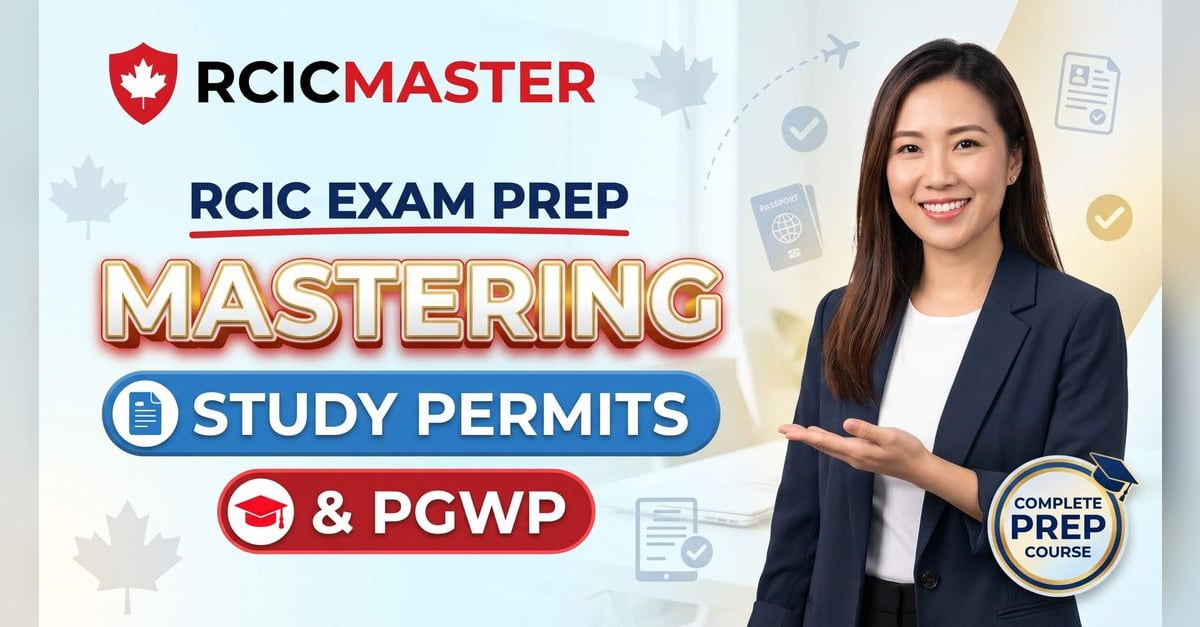
RCIC Exam Prep: Mastering Study Permits and PGWP · CAD $99 one-time payment · 3 months
Read every module and lesson before you buy. One payment, no subscription.
View the courseThis is practice preparation and is not endorsed by the regulator.
FAQ
How long is the course?
About 20 hours of content across 6 modules.
How much does it cost?
CAD $99, one-time payment, with 3 months of access.
Is the course endorsed by the regulator?
No. It is practice preparation and is not endorsed by the College.
Does it cover PGWP and study permits in the same course?
Yes. Two modules are dedicated to study permits and the PGWP, with the remaining modules covering legal foundations, procedural fairness, misrepresentation, professionalism and the exam.